

Short answer: an NGC details grade means the coin is genuine, but a problem such as cleaning or damage stops it getting a 1 to 70 number. It gets a wear grade instead, such as "XF Details", and the label names the problem. NGC says these coins are generally valued at least one grade below a problem-free coin, and sometimes two or more.
What is an NGC details grade? Three outcomes at NGC
Not every coin gets a number. The NGC details grade is one of three outcomes, and it helps to know all three.
A number from 1 to 70
No problems that stop a numeric grade. This is the "normal" slab.A wear grade plus the problem
Genuine coin with a problem. The label says, for example, XF Details and names the issue.Returned, not holdered
NGC will not encapsulate it. Reasons include harsh cleaning, questionable toning or material on the surface.Some problems can be fixed first. NGC says coins with active residues, such as PVC, must be conserved by NCS, an NGC affiliate, before grading. Our guide to the 7 mistakes that get coins downgraded covers how to avoid creating these problems.
What a Details label says
A Details label has three parts. First comes the wear grade, such as XF. Next comes the word DETAILS. Then the label names the problem.
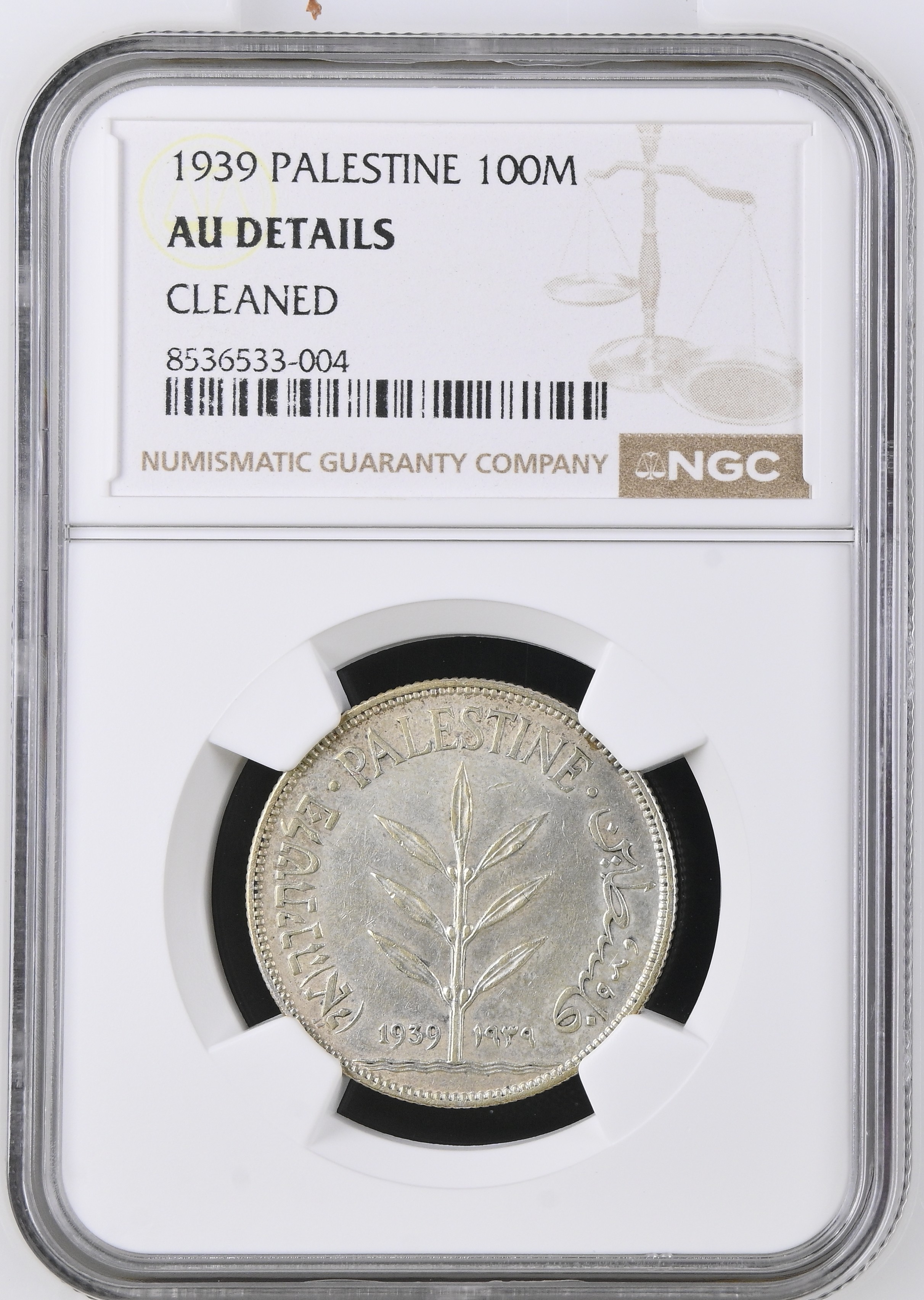
From our stock. Reading down: the coin, then the wear grade (AU) with the word DETAILS, then the problem (Cleaned), then the certification number.
The grade is adjectival, not numerical. It runs from UNC Details down to PR Details. NGC calls it a "wear grade", because it reflects how much metal the coin has lost to circulation.
One more clue helps with older slabs. NGC says coins certified before 2 January 2018 used a purple label.
Four real Details labels from our stock
Here are four NGC details grade slabs we have handled. Each one is a genuine coin with one named problem.
AU Details · Cleaned
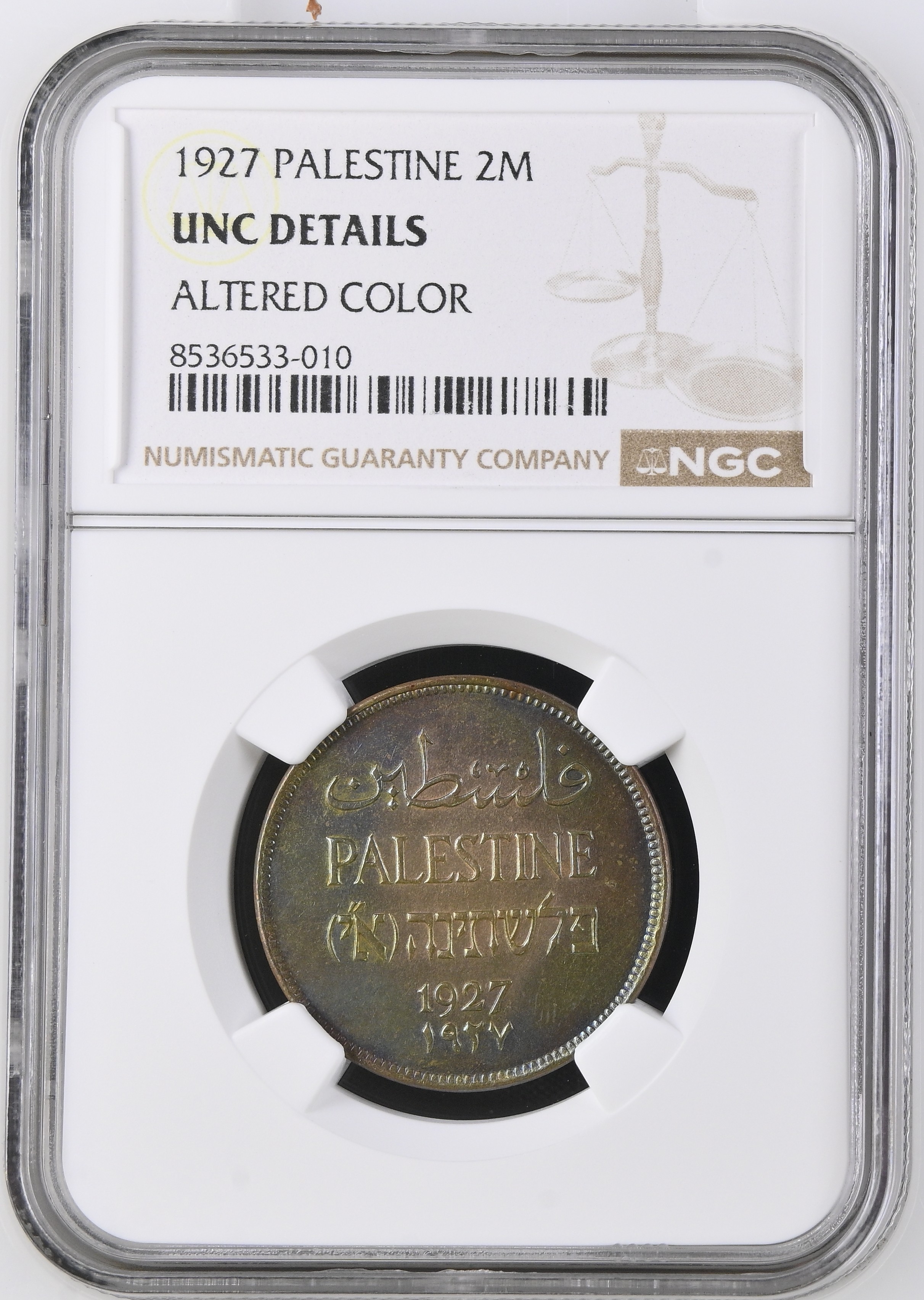
UNC Details · Altered Color
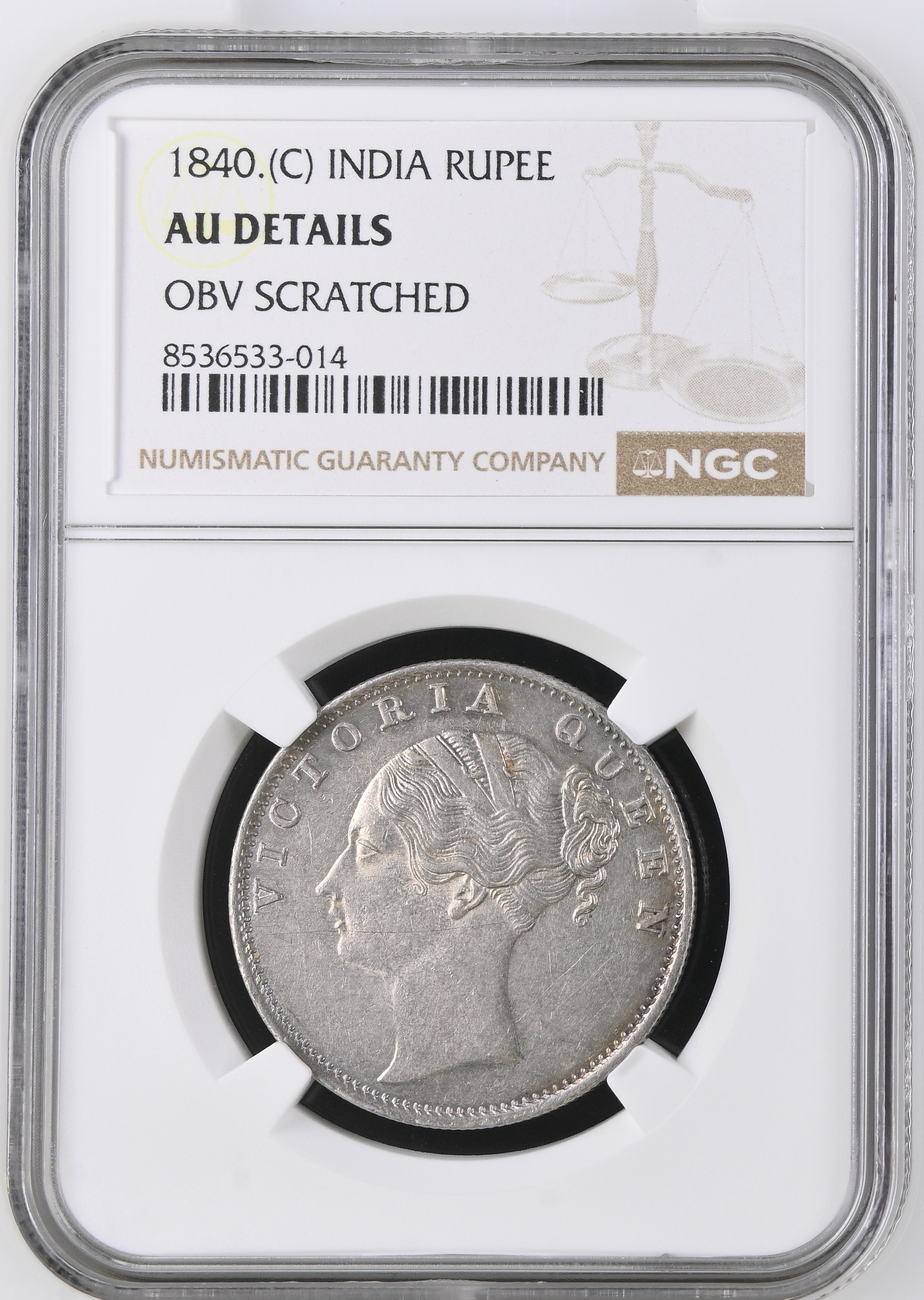
AU Details · Obv Scratched
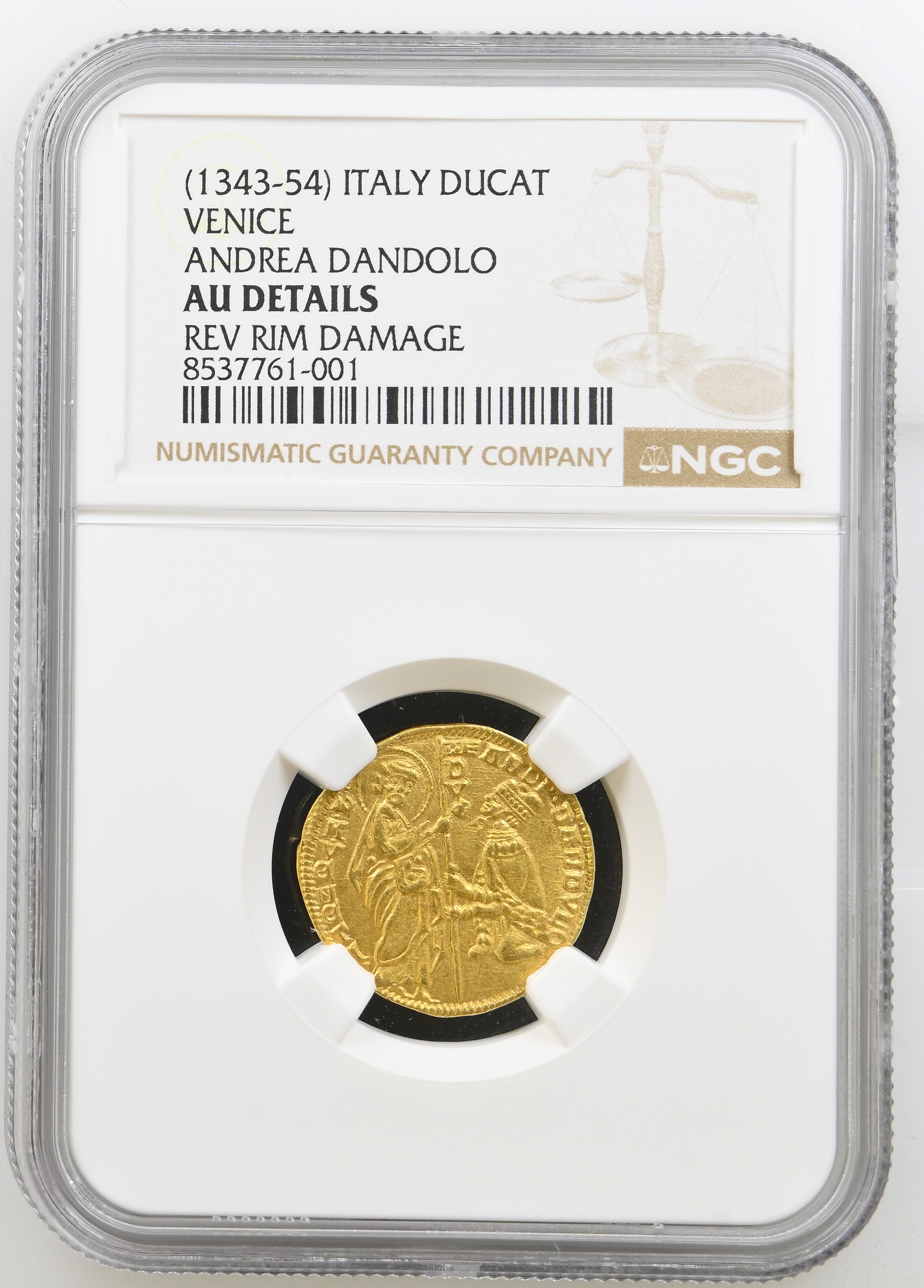
AU Details · Rev Rim Damage
| Coin | Grade | Label says | What it means |
|---|---|---|---|
| 1939 Palestine 100 Mils | AU Details | Cleaned | Cleaning category. The surface was wiped or cleaned at some point. |
| 1927 Palestine 2 Mils | UNC Details | Altered Color | Altered colour category. The colour is not natural. Note the vivid toning in the photo. |
| 1840 India Rupee | AU Details | Obv Scratched | Mechanical damage. "Obv" means the obverse, the front. |
| Venice ducat, 1343-54 | AU Details | Rev Rim Damage | Mechanical damage. "Rev" means the reverse, the back, and the damage is on the rim. |
Three lessons show up. First, wording varies, so "Cleaned" sits beside terms like "improperly cleaned" in NGC's lists. Second, labels use short forms such as Obv and Rev, and they tell you which side has the problem. Third, an NGC details grade can sit on a gold medieval coin as easily as on a silver rupee.
The problems NGC names on a Details label
NGC groups the problems into categories. Here they are in plain English.
| Category | Terms you may see |
|---|---|
| Environmental | Bronze disease, corrosion, environmental damage, stained. Caused by storage, heat, damp, pollutants or sea water. |
| Cleaning | Brushed, burnished, improperly cleaned, polished, spot removal, whizzed, wiped. |
| Altered colour | Artificial color, artificial toning. Chemicals, filler or heat changed the look. |
| Mechanical damage | Bent, chopmarked, countermarked, damaged, graffiti, mutilated, impaired (Proofs), mounted, soldered, scratches, wheel marks. |
| Mechanical repair | Plugged hole, tooled or re-engraved, smoothing, rim filed or repaired, mount removed. |
| Mint-made | Planchet flaw, clipped planchet. Minor flaws from manufacture. |
A single label can list more than one problem. And the label alone says little about how bad the problem is. That is where your own eyes come in.
Want to see graded coins in person? Browse our stock.
Shop the coin store →What a Details grade does to value
NGC is direct about this. A Details coin is generally valued at least one grade below its straight-graded equivalent. Sometimes the gap is two grades or more.
What decides the discount
- Severity. A faint problem costs little. A harsh one costs a lot.
- Location. Damage on the face of the coin matters more than a small edge mark.
- The coin itself. A rare coin may still be worth owning with a flaw.
The trade-offs
- Problem coins are less liquid. They can be harder to resell.
- Cheap problem coins are often a poor long-term holding, says NGC.
- Two Details labels can look the same but hide very different coins.
So there is no single number. The best method is to compare real auction results for similar coins with similar problems. Then look closely at the photos.
We found no clean public data for a fixed Details discount, so we will not make one up. If you are weighing grading fees against value, see our real auction price guide on graded vs ungraded coins.
Ancient coins work differently
The Details system above is for modern coins. NGC grades ancient coins another way.
An ancient coin gets an adjective grade, plus Strike and Surface scores out of 5. Cleaning falls under Surface. And NGC records noteworthy features in a note on the label.
We show this on real slabs in our guide to ancient coin grading. Two of our Alexander III tetradrachms carry the note "brushed". Yet they still received a normal grade of Ch XF, with Strike 5/5 and Surface 3/5. For a modern coin, NGC lists "brushed" as a cleaning term in the Details system.
The lesson is simple. Always read the whole label, not just the grade.
Sending a coin to NGC from the UK
If you are in the UK, an NGC details grade can still happen to a coin you submit, so it helps to know the route. NGC UK accepts modern and vintage coins. But NGC says ancient coins and pre-1800 Islamic hammered coins must go to NGC's US headquarters instead.
Only paid NGC members and NGC Authorized Dealers can submit coins. Pashiz Coins is an NGC authorised dealer in London, so you can ask us about submitting.
NGC UK lists its bulk fees as £27.60 per modern coin and £32.40 per vintage coin including VAT. It adds £13.20 handling and £6.00 return packaging per form. Fees change, so always check NGC's current price list before you send anything.
A Details result is always possible, so look hard at a coin for cleaning or damage before you decide to submit it.
Details label reader
Decode a Details label
Pick the grade and the problem printed on the label.
When a Details coin makes sense
It can make sense when
- The coin is rare, and a straight-graded one costs far more.
- The problem is mild and the price reflects it.
- You want a genuine, authenticated example for your collection.
- You love the coin and will keep it.
Think twice when
- You are buying purely to resell.
- The problem is on the face of the coin.
- The price is close to a problem-free coin.
- You have not seen clear photos of both sides.
- Read the problem named on the label.
- Ask for large photos of both sides.
- Check recent auction results for similar Details coins.
- Compare the price with a straight-graded coin of the same wear.
- Decide if you would still love it with the flaw.
Avoid creating the problem. Cleaning is the most common way a coin ends up with a Details grade. Never clean a coin before grading. See our guide to coin grading mistakes.
Questions people ask
What is an NGC details grade?
It is a grade for a genuine coin that has a problem. The coin gets a wear grade, such as XF Details, plus a label note naming the problem.
Is a Details coin genuine?
NGC certifies Details coins and holders them with the problem noted. NGC describes this as a way for collectors to buy authenticated coins. Coins that fail are returned without a number.
Is a Details grade bad?
Not always. It is a statement of fact. Some coins are still rare and worth owning. But expect a lower price than a problem-free coin.
How much less is a Details coin worth?
NGC says generally at least one grade less, and sometimes two or more. The exact amount depends on the coin and the problem.
Why did NGC not give my coin a grade at all?
Harsh cleaning, questionable toning, material on the surface and similar issues can lead to a "no grade". Some can be fixed by conservation first.
Can a Details coin be upgraded to a number?
That is a question for NGC. The Details grade comes from a problem that stays on the coin. Contact us before you resubmit anything.
Thinking of grading a coin?
Ask us before you send it. As an NGC authorised dealer, we can look at your coin with you before you send it.
NGC grading service Shop the coin store WhatsApp usSources: NGC, NGC Details Grading; NGC, A Closer Look at Details Grading; NGC, The Mystery of No Grades; NGC, NGC Ancients: Grading. The label picture is an illustration, not a real coin.