

Geyhatu Khan: Ilkhanid Ruler & His Coinage
غیخاتو
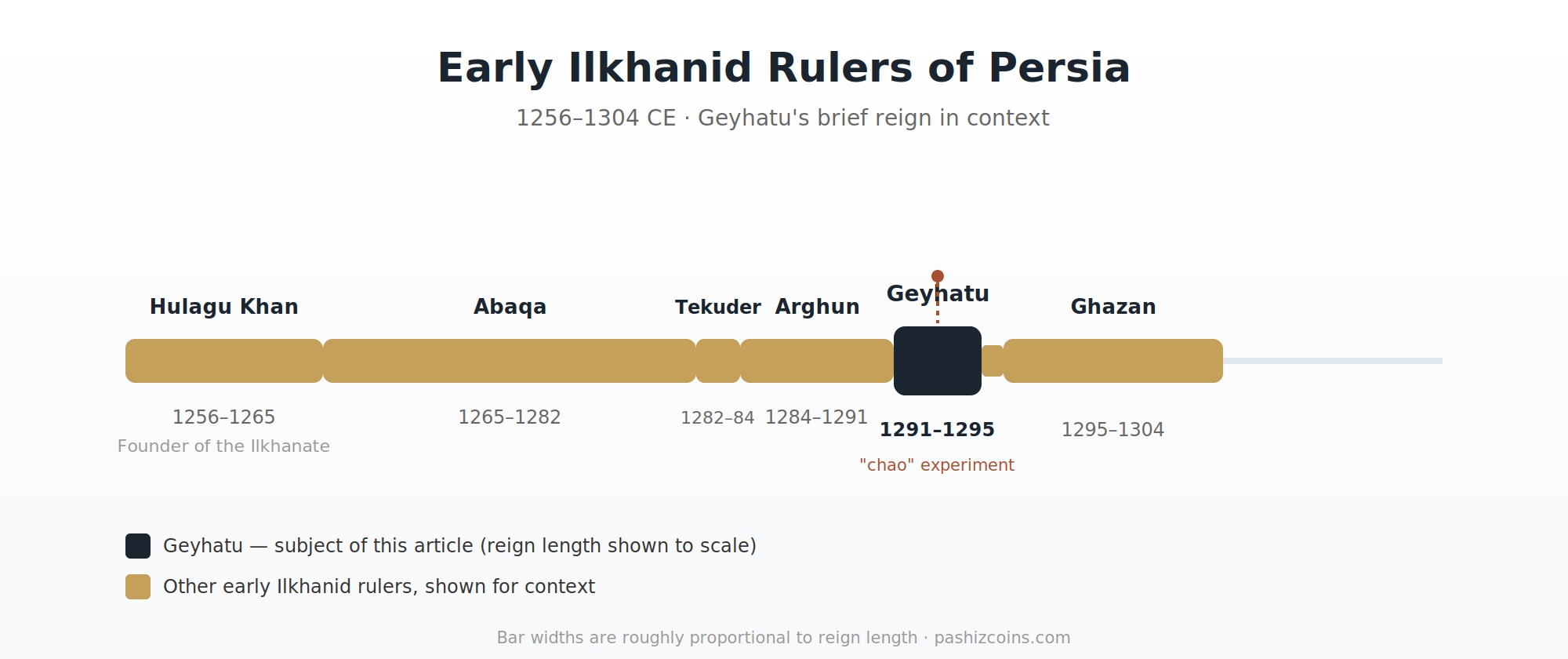
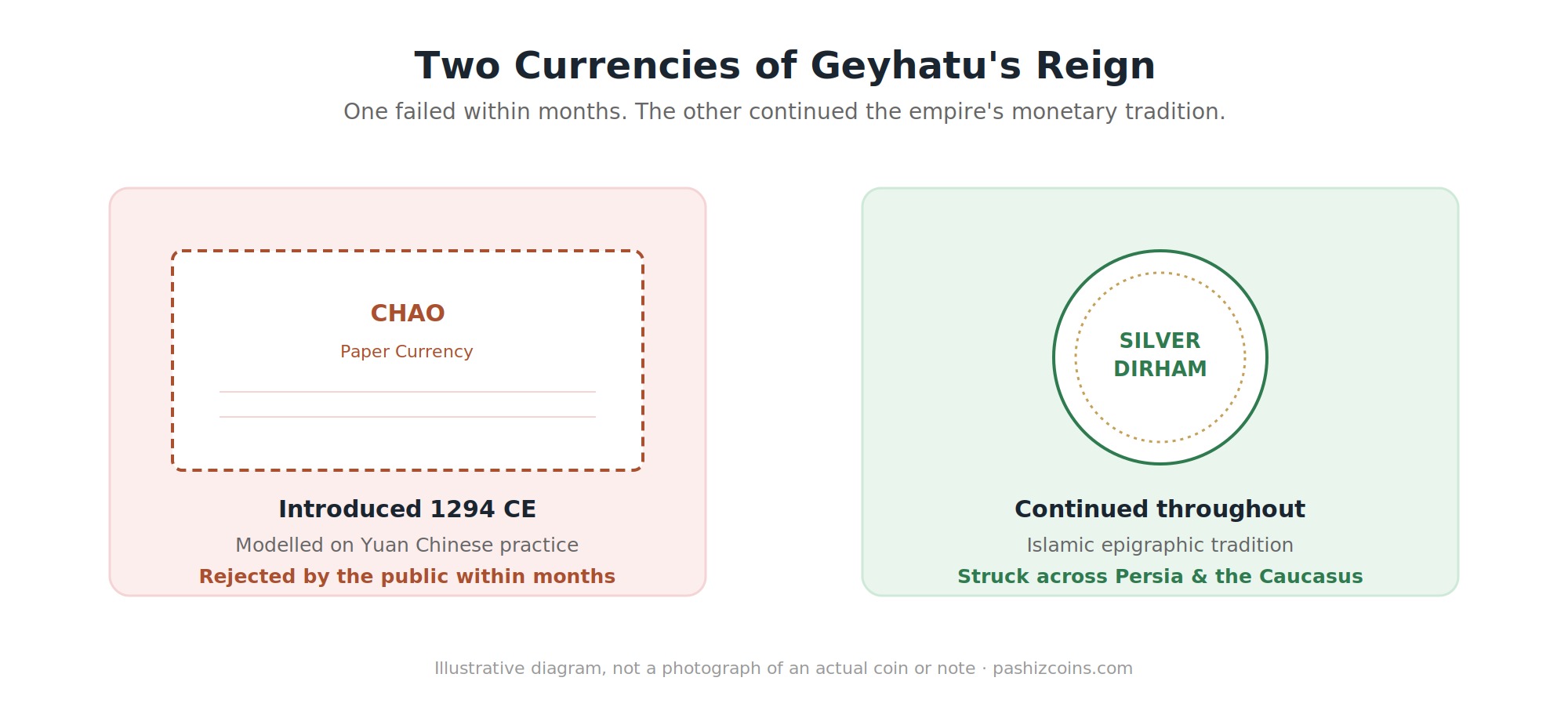
Geyhatu ruled the Mongol Ilkhanate of Persia from 1291 to 1295 CE — a short and largely unsuccessful reign remembered chiefly for one genuinely dramatic episode: the introduction of paper currency known as chao, modelled directly on the system already in use in Yuan China under Mongol rule there. The experiment collapsed within months, amid widespread public refusal to accept the new currency and severe resulting economic disruption across the Ilkhanate. It stands today as one of the earliest documented attempts to introduce paper money into the Islamic world, and a striking — if unsuccessful — footnote in the broader history of monetary systems.
BackgroundThe Political Context of Geyhatu's Reign
Geyhatu came to power following the death of his brother, Arghun Khan, at a moment when the Ilkhanate — the Mongol-ruled successor state covering much of Persia, the Caucasus, and parts of Anatolia and Mesopotamia — was already under considerable fiscal strain from years of military campaigning and administrative expansion. His response, advised by finance minister Sadr al-Din Zanjani, was the chao experiment: an attempt to solve a genuine treasury shortfall through currency innovation rather than through the more conventional (and more disruptive) routes of taxation increases or debasement.
NumismaticsCoinage Under Geyhatu
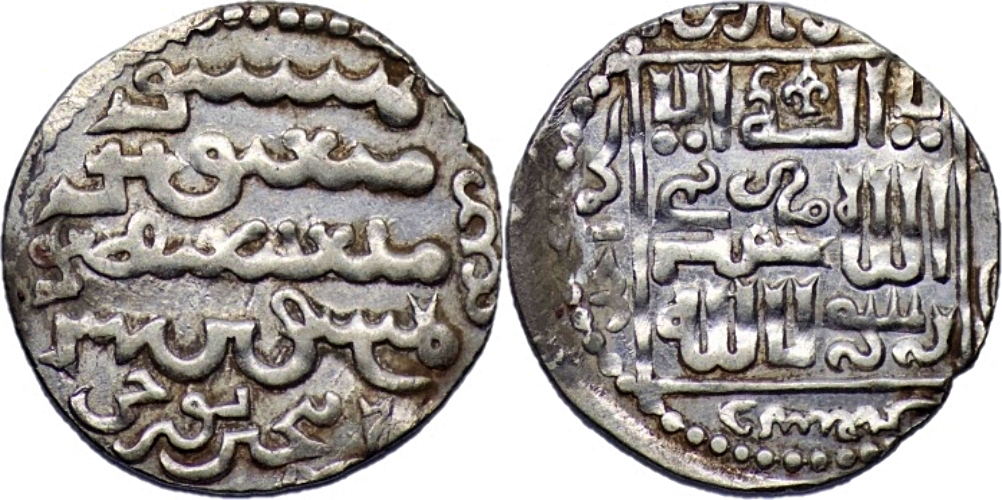
Alongside the short-lived and ultimately abandoned paper currency, Geyhatu's reign produced conventional silver dirham coinage minted across the Ilkhanate's territory in Persia and parts of the Caucasus and Anatolia. This coinage continued the broadly Islamic epigraphic tradition that Mongol Ilkhanid rulers had adopted following their conversion — or at minimum administrative accommodation — to Islamic governance norms within their Persian territories. Ilkhanid dirhams of this period are of particular interest to collectors and historians researching the intersection of Mongol political authority and established Persian/Islamic monetary tradition: a genuinely hybrid system that borrowed heavily from earlier Abbasid and Seljuk minting conventions while unmistakably marking the political reality of Mongol rule.
CollectingWhy Collectors Are Drawn to This Period
The late 13th-century Ilkhanate is a genuinely underappreciated area of Islamic and Persian numismatics — a period of significant political and economic experimentation, of which the chao episode is only the most dramatic example, directly reflected in the coinage of the time. Because Geyhatu's reign was brief, dirhams struck specifically during his four years on the throne are relatively scarce compared to those of longer-reigning Ilkhans such as his predecessors and successors, making them a genuine point of specialist interest for collectors focused on this transitional Mongol-Persian period.
Buyer's NoteWhat to Look For When Buying Ilkhanid Coins From This Era
As with most medieval Islamic coinage, mint and date attribution in the marginal inscription is central to correctly identifying a specific issue — Ilkhanid dirhams were struck across a fairly wide network of Persian and Caucasian mints, and pinning down exactly where and when a given coin was produced adds significantly to its historical and collector interest.
FAQFrequently Asked Questions
What is "chao" and did any of Geyhatu's paper currency survive?
Chao was the paper currency introduced under Geyhatu, modelled on Yuan Chinese practice. Surviving examples are extremely rare historical artefacts rather than something a typical collector will encounter; the far more commonly available material from this reign is the conventional silver dirham coinage.
Are Geyhatu's coins rarer than other Ilkhanid rulers?
Generally yes, relative to longer-reigning Ilkhans, simply because his reign was short — fewer years of minting activity typically means fewer surviving examples today.
How can I tell a Geyhatu dirham from other Ilkhanid coinage?
Attribution comes down to reading the ruler's name and titulature in the coin's inscription alongside the mint and date in the margin — a task best confirmed by a specialist dealer if you're not confident reading the script yourself.
We carry Ilkhanid-era coinage as stock permits. Browse our Central Asian and Ilkhanid coins or contact us about specific rulers or mints you're researching.