

How to Spot a Fake Ancient Coin
A complete buyer's checklist for authenticating ancient coins online
Ancient coins are among the most reproduced collectibles in the world. The combination of genuinely high value, a limited and finite surviving supply, and buyers who often can't inspect a piece in person before paying makes ancient coinage a persistent target — both for honest, clearly-marked reproductions sold as such, and for deliberate forgeries designed to deceive. If you're buying ancient coins online, whether it's your first purchase or your fiftieth, here is a complete, practical checklist for protecting yourself.
BackgroundWhy Ancient Coin Forgery Is Such a Specific Problem
Unlike modern collectibles, ancient coins were hand-produced using techniques — striking between hand-engraved dies — that are genuinely difficult to replicate convincingly at scale, even with modern technology. That's good news for buyers, because it means most forgeries, examined closely, do show detectable flaws. The challenge is that "examined closely" usually requires either specialist knowledge or third-party authentication, since photographs alone rarely tell the full story.
The ChecklistThe 6-Point Authentication Checklist
Work through these six checks before buying any ancient coin — particularly anything above a modest price point.
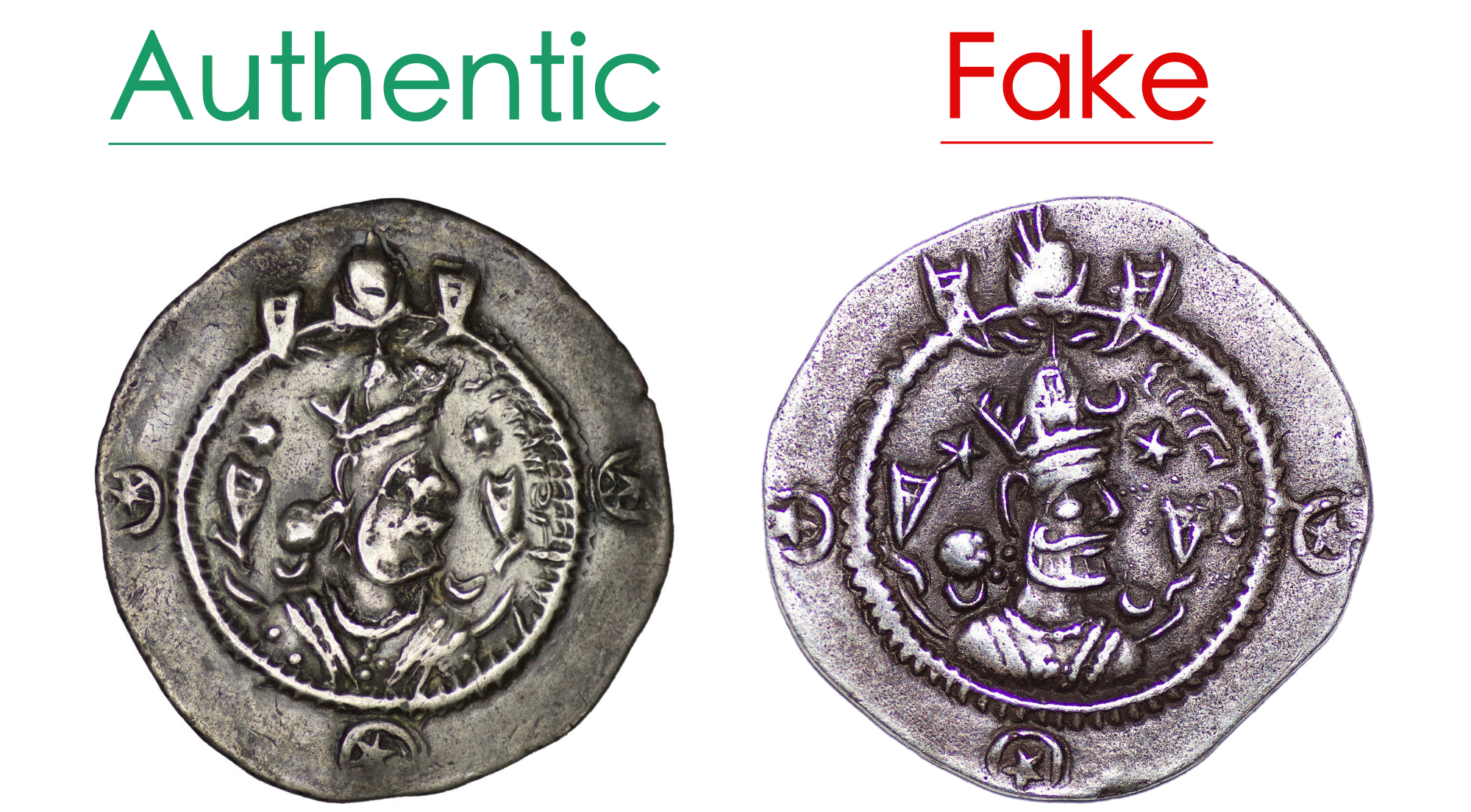
-
Weight and dimensions
Genuine ancient coins were struck to fairly consistent weight standards for their specific type, denomination, and period — a Roman denarius, a Sasanian drachm, and an Umayyad dirham each have known, well-documented weight ranges. A trustworthy listing will give you exact weight (in grams) and diameter (in millimetres), and a knowledgeable seller will be able to discuss how a specific coin's weight compares to the expected standard for its type. Vague listings with no measurements, or sellers who can't answer basic weight questions, are a warning sign worth taking seriously.
-
Surface and strike characteristics
Ancient coins were hand-struck between two engraved dies, which leaves specific, genuinely difficult-to-fake characteristics: slightly irregular, organic-looking flans (the blank metal disc before striking), natural die wear and die breaks that vary coin to coin even within the same issue, and toning that develops unevenly and gradually over many centuries of burial and handling. Cast fakes — as opposed to genuinely struck coins — very often show a tell-tale seam line around the edge, softer and less defined detail throughout, or an unnaturally uniform, waxy surface texture that doesn't match how metal actually ages.
-
Provenance and collecting history
Ask directly: where has this coin been before it reached this listing? A dealer who can tell you even a brief collecting history — a previous auction appearance, a named prior collection, or documentation going back further — is demonstrating both transparency and a level of due diligence that most forgery operations simply don't bother with, because provenance research is exactly the kind of scrutiny that exposes fakes. The absence of any provenance isn't automatically a red flag on its own (many genuine ancient coins have limited documented history), but a seller's willingness to discuss it, and the quality of what they can tell you, says a great deal.
-
Third-party authentication
For anything above a modest price point, a coin independently graded and authenticated by NGC Ancients (or a comparably recognised service) has already been examined by specialists whose entire professional reputation rests on getting authentication right. This is, without much competition, the single most reliable protection available to a buyer who can't physically inspect a coin before purchase — you're not relying on a seller's word, a stock photograph, or your own developing expertise; you're relying on an independent, verifiable certification with its own lookup database.
-
Dealer reputation and returns policy
A dealer with a genuine, verifiable trading history, physical premises you can visit, and a clear, honoured returns policy has considerably more to lose from selling a fake than an anonymous online-only seller with no fixed address and a fresh account. Before buying anything significant, it's worth checking how long a dealer has been trading, whether they have a real gallery or shop, and what happens if a coin turns out not to be as described.
-
Price — when it's too good to be true
This is an obvious point, but worth stating plainly: a price significantly below the going market rate for a genuine example of that type is far more often a sign of a fake, a misattribution, or a reproduction than a genuine bargain. Ancient coin pricing is reasonably well documented across auction records and dealer catalogues — if something looks like an outlier, treat that as a reason for extra scrutiny, not extra excitement.
A note on reproductions vs. fakes
Not every reproduction is dishonest. Many are sold openly as such — museum-shop souvenirs, teaching aids, or decorative pieces — and are perfectly legitimate as long as they're clearly disclosed. The problem is specifically reproductions passed off as genuine. If a price looks like an outlier and the seller can't explain why, that's the moment for extra scrutiny, not extra excitement.
Our StandardOur Approach at Pashiz Coins
Every ancient coin we sell is personally examined and authenticated by our specialists before it's ever listed, and as an authorised NGC and PMG dealer, we're also able to offer third-party certification for buyers who want that additional layer of independent verification. If you're ever unsure about a coin — ours or one you've seen elsewhere — we're genuinely happy to give you an honest opinion; it costs you nothing to ask.
FAQFrequently Asked Questions
Can a photograph alone confirm a coin is genuine?
Not reliably. Good photographs help, but weight, exact surface texture, and certain die characteristics are very hard to fully assess from images alone — this is exactly why third-party grading matters for anything of real value.
Are all reproduction coins sold as fakes?
No — many reproductions are honestly sold as such, often as museum-shop souvenirs or teaching aids, and are perfectly legitimate as long as they're clearly disclosed. The problem is specifically reproductions passed off as genuine.
Does a low price always mean a coin is fake?
Not always — genuine bargains do exist, particularly for common types. But an unusually low price on a coin that would normally be expensive is a signal to look closer, not a reason to buy quickly before "missing out."
Browse our current authenticated ancient coins or read more about our NGC and PMG grading services.