

7 Mistakes That Get Coins Downgraded (Never Clean Your Coin)
Never clean your coin. Most coin grading mistakes are things people do to “help”, and none of them can be undone. Hold coins by the edge, store them in safe holders, and ask us before you touch, dip, glue or post anything.
A coin that comes back from grading with a low score has not been “downgraded” by the grader. It has simply scored lower than it could have done. In most cases the cause is something that happened to the coin before it was submitted.
The good news is that every mistake in this guide is easy to avoid. The bad news is that you cannot fix them afterwards.
The basicsWhy condition matters so much
A grade has two parts: how worn the coin is, and what has happened to its surface. Wear comes from the coin’s past, and you cannot change it. Surface damage is different, because it is often caused by an owner.
NGC lists cleaning, cleaning hairlines, polishing, smoothing and altered patina as surface factors on ancient coins. It also records noteworthy ones on the label. Any of these can lower the Surface score, and buyers read that score closely.
The listThe 7 mistakes
Cleaning the coin
“It was dirty, so I gave it a quick wipe.”
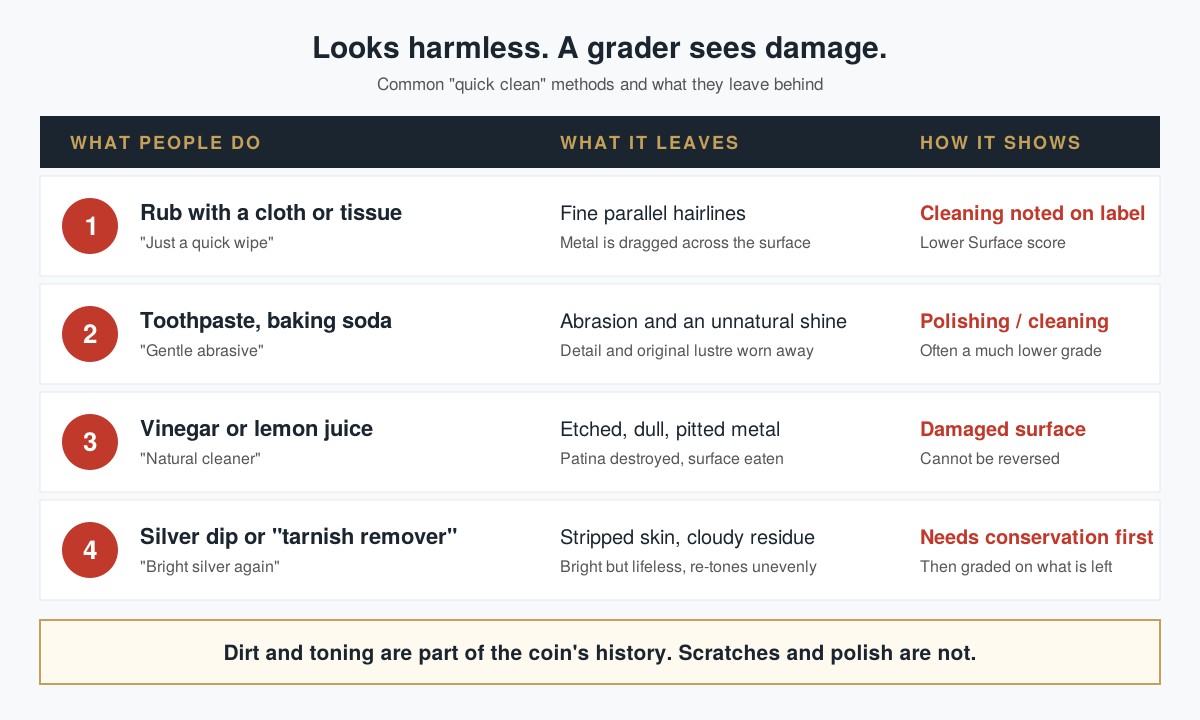
This is the big one. Rubbing, polishing or soaking a coin leaves fine hairlines or strips the original surface. A coin that has lost its natural surface looks flat and bright, and experienced buyers spot it at once.
Dirt and soil on an ancient coin are part of its history. A skilled conservator can remove them safely. A cloth, toothpaste or a toothbrush cannot.
Dipping or “improving” the toning
“The silver is dark. A dip will brighten it.”
Silver dips strip the surface along with the tarnish. Done badly, they leave a cloudy or brownish film. NGC calls this dip residue, and it says coins with it need conservation before they can be certified.
Artificial toning is just as risky. Toning applied with heat or chemicals can look attractive, but it is a surface change and graders look for it.
Touching the face of the coin
“I only held it for a moment.”
Skin carries oils and salts. On a coin they can leave fingerprints that stay for good, especially on silver and on high points of the design.
Storing it in soft plastic flips
“The flip was cheap and it fitted perfectly.”
Soft, flexible flips often contain PVC. Over time PVC can leach out, especially in warm or humid rooms. It starts as a faint haze, then becomes green spots or a green film. NGC says PVC is an active contaminant that can keep causing damage.
NGC will not certify a coin with active PVC. It has to go through NGC Conservation (NCS) first. If the surface underneath has already been etched, the coin can still be graded, but it may carry a mark for environmental damage.
Avoid sticky tape, rubber bands, old paper envelopes and cardboard of unknown quality as well.
Fixing it yourself
“I filled the scratch and glued the loop back.”
Glue, filler, lacquer, ink and tape all count as foreign material. NGC lists glue residue, lacquer and residue among the things that need conservation before certification. Tooling, re-cutting and re-engraving are also surface factors on ancient coins, and graders note them.
Posting it carelessly
“I put it in a padded envelope.”
A loose coin rattles around. Rim knocks and new scratches are easy to cause and impossible to remove. A coin can also be damaged by a staple or by a clip that presses on the surface.
Skipping the pre-check
“I will just send everything and see.”
Not every coin is worth grading, and not every coin is accepted. NGC does not grade ancient Indian coins, and it takes Sasanian coins only at its discretion. A damaged coin may cost more to grade than the label adds in value.
The evidenceWhat cleaning actually does
Most people who clean a coin think they are being gentle. The table below shows what common “quick clean” methods leave behind and how a grader sees them.
Try itWhat is on my coin?
Pick what you can see on your coin. The checker gives a safe next step. It is a guide, not a replacement for a proper look, so send us a photo if you are unsure.
Coin problem checker
Good habitsHow to handle and store coins safely
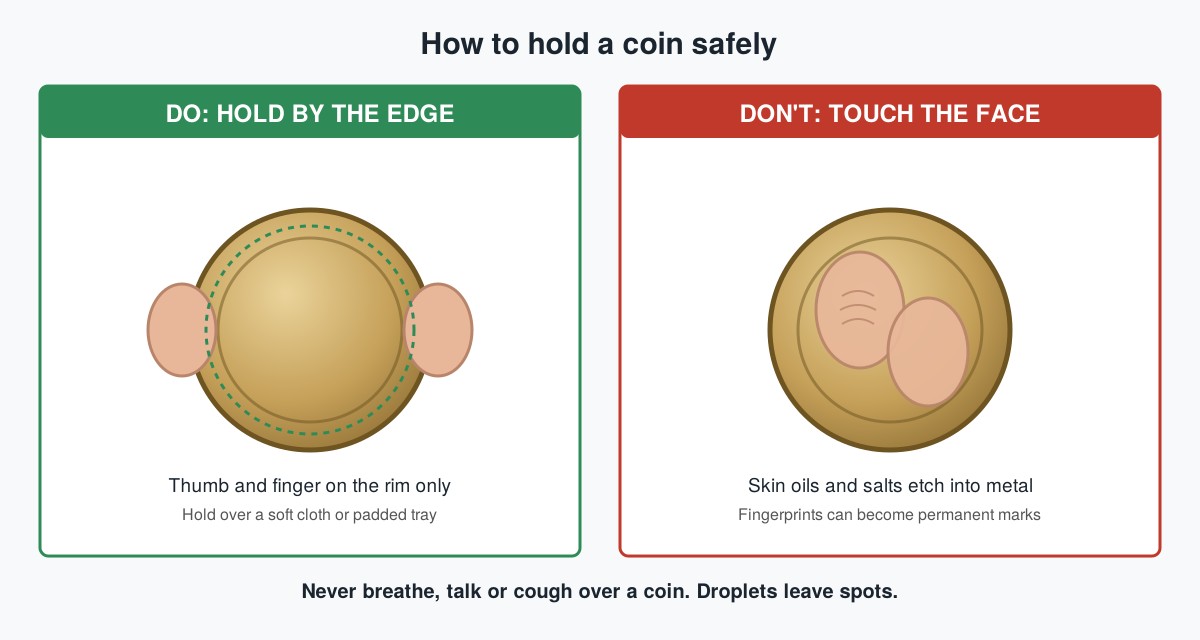
- Wash and dry your hands first, or wear clean cotton or nitrile gloves.
- Hold the coin over a soft cloth, in case it slips.
- Pick it up by the rim. Never touch the faces.
- Do not breathe, talk or cough over the coin.
- Store it in PVC-free, inert holders in a cool, dry place.
- Keep silica gel in the storage box if your home is damp.
- Check stored coins once or twice a year for changes.
QuestionsFrequently asked questions
Does cleaning always lower a coin’s grade?
It nearly always lowers the Surface score on an ancient coin, and NGC may record the cleaning on the label. How much it matters depends on the coin and how heavy the cleaning was.
Is it ever right to clean a coin?
Sometimes a coin needs professional conservation, such as removing PVC residue or glue. That is a job for NGC Conservation or a trained conservator, not for a cloth or a chemical at home.
My coin has green spots. What should I do?
Do not scrape or pick at them. Green spots can be harmless old patina or active corrosion. Send us a photo and we will tell you which it is.
Can I remove a coin from its old flip myself?
If the flip is soft plastic, yes, but only carefully and by the rim. Check the coin for a film or haze first. If you see one, stop and ask us.
Will graders be able to tell if I cleaned the coin?
In most cases, yes. Hairlines, an unnatural shine and a missing patina are hard to hide, and graders see thousands of coins.
Is it worth grading a coin that has been cleaned?
Sometimes. It depends on the coin, its rarity and the cost. Send us a photo and we will give you an honest view before you spend anything.
Sources
- NGC Ancients: grading guidelines
- NGC: coins that require conservation prior to certification
- CoinWeek: NCS conservation, treating PVC residue
Not sure about your coin?
Send us a photo before you do anything to it. We will tell you what it is, whether it needs help and whether grading is worth it.
NGC submission form (PDF) Ask us about grading