

Short answer: in ancient coin grading, Strike 5/5 and Surface 4/5 are two separate scores out of 5. Strike rates how well the coin was made. Surface rates its condition today. Each point covers 20% of the scale, so 5/5 does not mean perfect. Neither score measures wear. The grade does that.
What an ancient coin label shows
Modern coins get a number from 1 to 70. Ancient coins do not. NGC Ancients uses words such as Choice Very Fine or Extremely Fine instead. It then adds two scores out of 5.
Here is a real ancient coin label, from one of the slabs we hold. We have numbered every part.
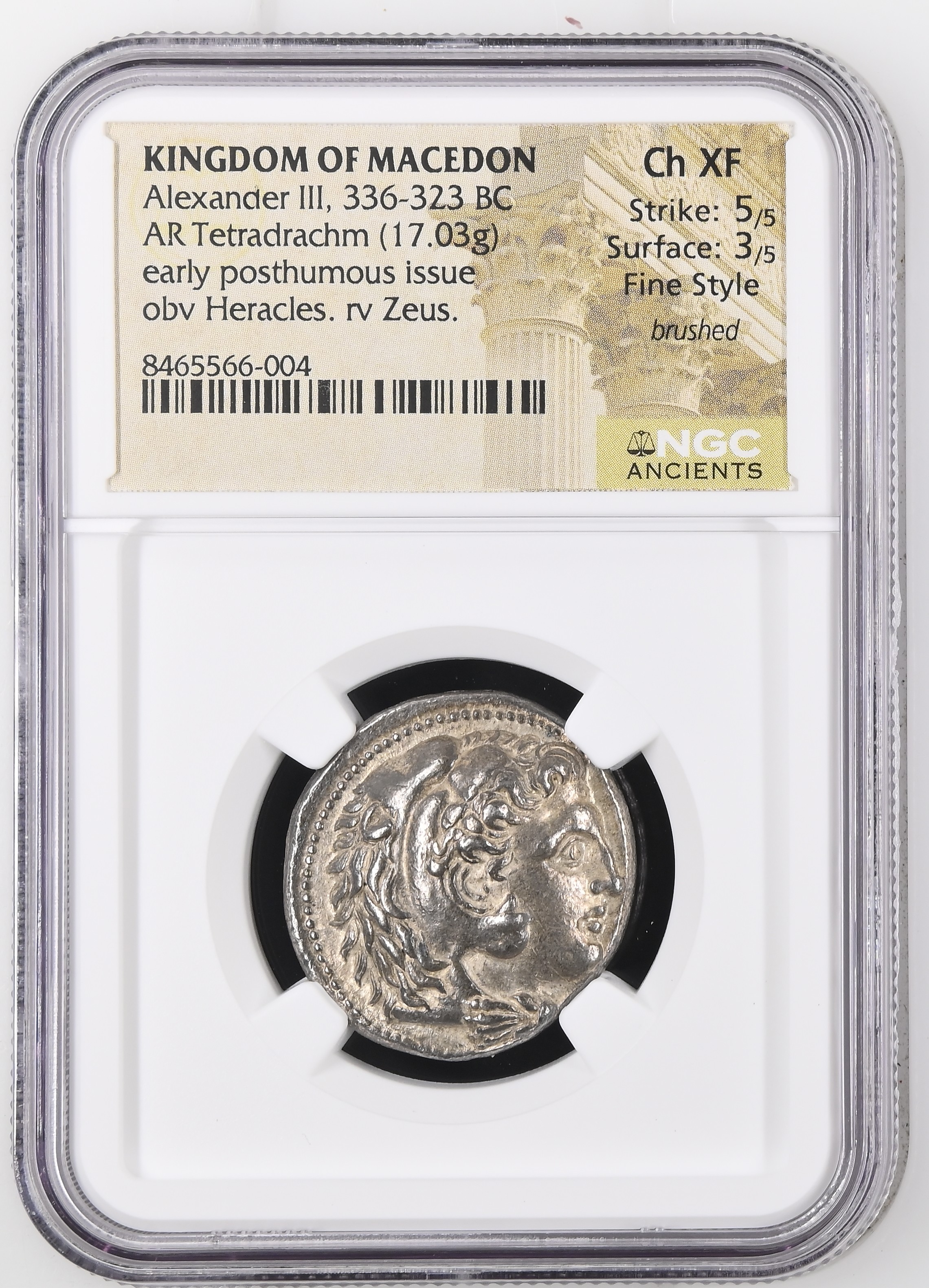 12345678910
- 1Issuer, ruler and dateKINGDOM OF MACEDON · Alexander III, 336-323 BC Who struck it, and when. BC dates count down.
- 2Metal, type and weightAR Tetradrachm (17.03g) AR is the symbol for silver. The weight is in grams.
- 3Descriptionearly posthumous issue · obv Heracles. rv Zeus. Obv is the front, rv is the back. Posthumous means struck after his death.
- 4The gradeCh XF Choice Extremely Fine. This is wear only.
- 5Strike5/5 How well the coin was made.
- 6Surface3/5 The condition of the metal skin.
- 7Fine StyleSuperior die engraving and design. It appears only when the coin earns it.
- 8Label notebrushed NGC records noteworthy surface features here. NGC counts cleaning under Surface, so this note fits the 3/5.
- 9Certificate number8465566-004 Invoice number, then the coin's line on it.
- 10The NGC Ancients markThe grader, and the ancient coin version of the label.
NGC grades four things on every ancient coin: grade, strike, surface and style. The label gives you the first three as scores. Style appears only when the coin earns it.
| Part | What it measures | What it ignores |
|---|---|---|
| Grade | Wear. How much design remains. | Strike and surface faults, which are scored separately |
| Strike | How well the coin was struck | Wear. Die engraving, which is Style. |
| Surface | The condition of the metal surface | Wear from circulation |
| Style | Quality of the die engraving and design | Strike and surface, though poor ones can block it |
Strike, explained
Strike is about the making of the coin. Ancient coins were struck by hand. A worker hammered a blank metal disc between two dies.
That process is easy to get wrong. NGC looks at four things:
- How well the design is centred on the coin.
- How strong and even the strike is.
- Cracks and flaws in the blank (the planchet).
- The state of the dies, such as wear, breaks, rust or clashing.
A 5/5 strike means the coin is in the top fifth of the scale. It does not need to be flawless. A 2/5 coin might be badly off-centre or weakly struck in places.
Surface, explained
Surface is the coin's skin. It covers luster, corrosion, porosity, crust, marks, hairlines and scratches. NGC also counts cleaning and, for bronze, patina.
Surface does not include wear. A coin can be worn and still have a clean surface. A coin can be sharp and still have rough, corroded metal.
So a 4/5 surface sits in the fourth band of five. It is a strong score. It tells you the surface has some small faults, but not serious ones. Be careful here. NGC does not publish a word-for-word meaning for each score. Treat the numbers as relative, and judge the photos yourself.
Cleaning shows up here. A cleaned coin takes a hit on surface, and NGC can note the cleaning on the label. Read our guide to the 7 mistakes that get coins downgraded.
Four real slabs side by side
Here are four NGC Ancients slabs from our stock. Look at the label first, then at the coin.
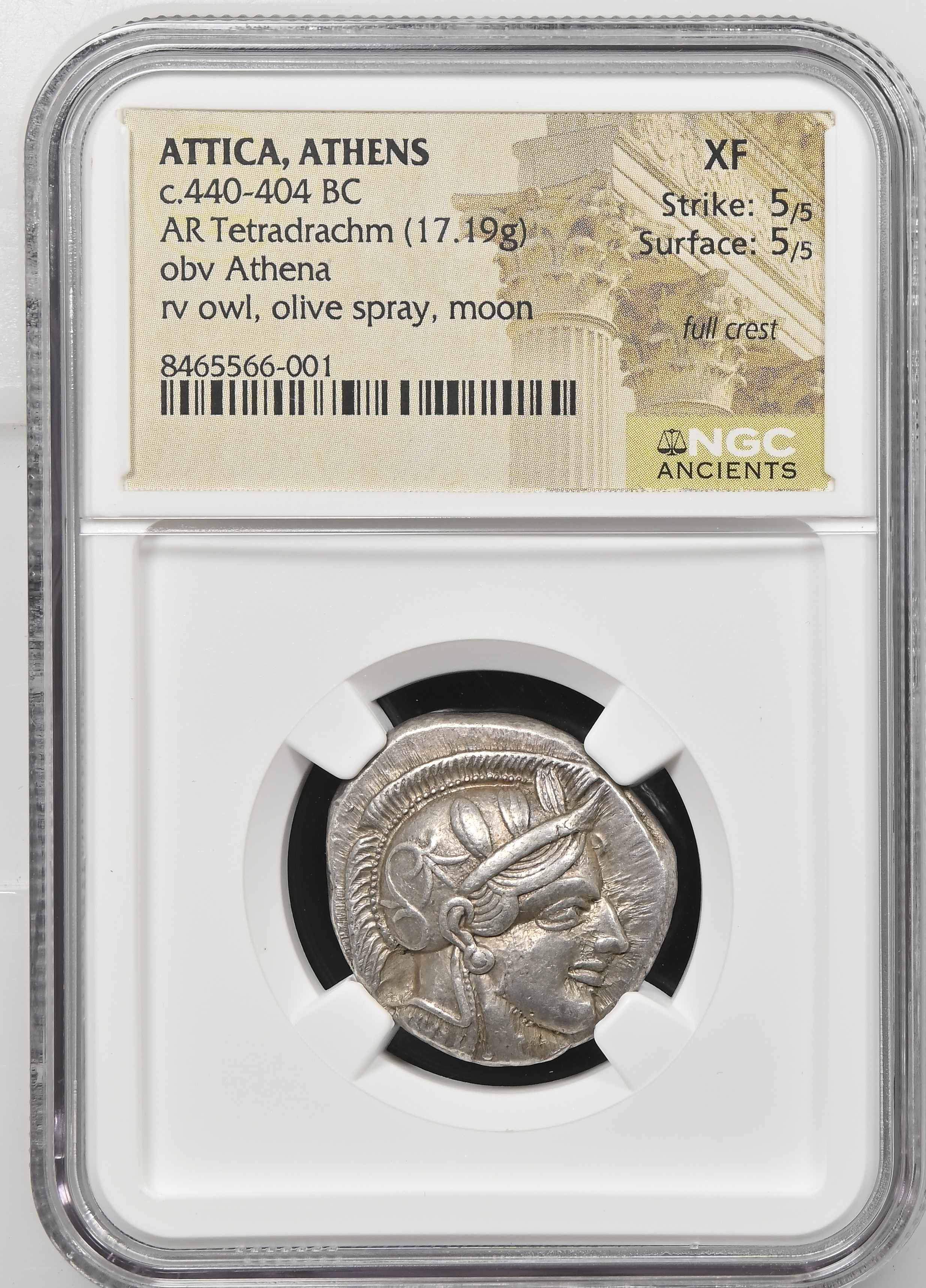
XF · 5/5 · 5/5
Ch XF · 5/5 · 3/5 · Fine Style
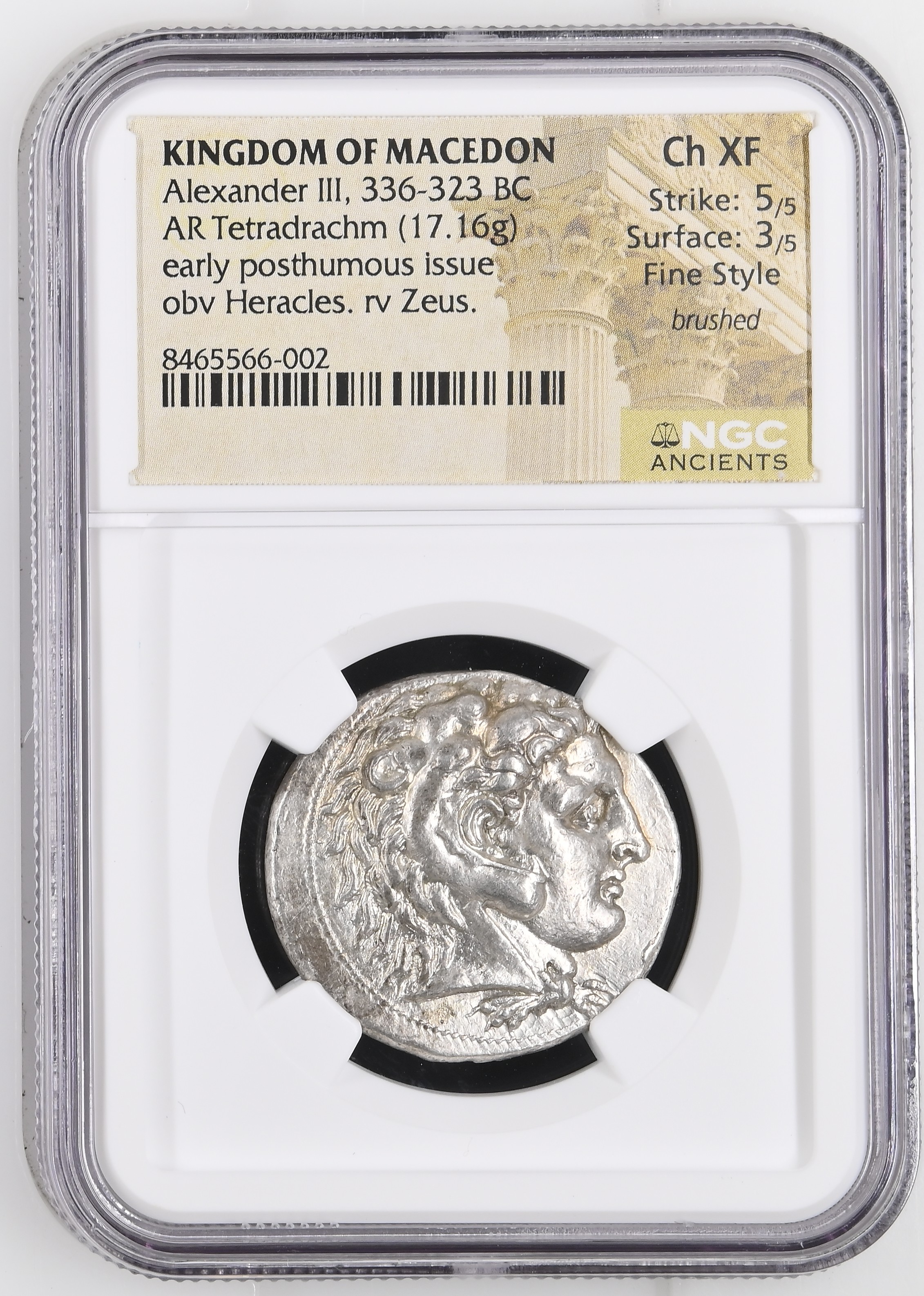
Ch XF · 5/5 · 3/5 · Fine Style
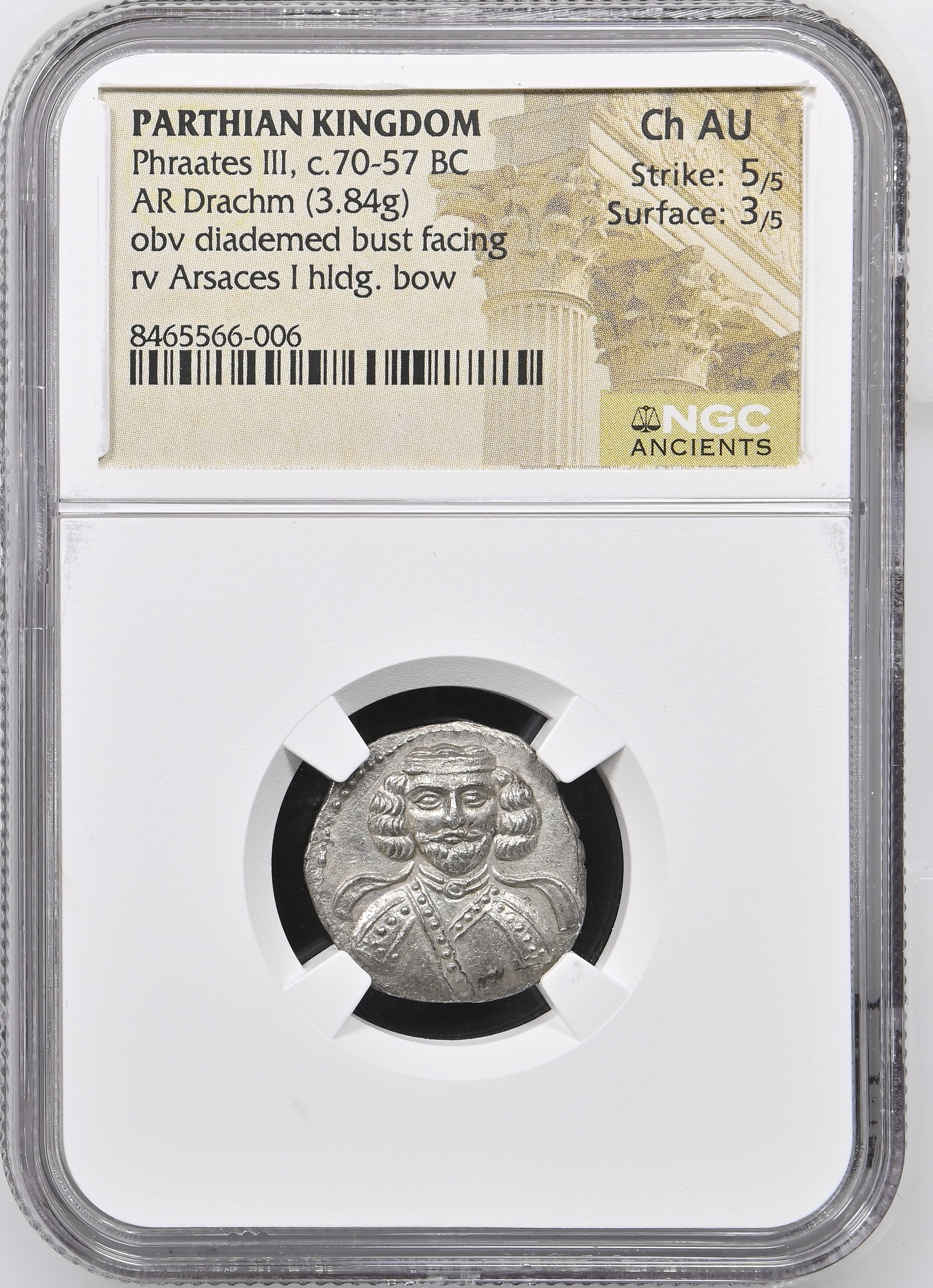
Ch AU · 5/5 · 3/5
| Coin | Grade | Strike | Surface | Extras on the label |
|---|---|---|---|---|
| Athens tetradrachm, c.440-404 BC | XF | 5/5 | 5/5 | "full crest" |
| Alexander III tetradrachm (-004) | Ch XF | 5/5 | 3/5 | Fine Style, "brushed" |
| Alexander III tetradrachm (-002) | Ch XF | 5/5 | 3/5 | Fine Style, "brushed" |
| Phraates III drachm, c.70-57 BC | Ch AU | 5/5 | 3/5 | None |
Three things stand out.
- The higher grade does not have the best surface. The Athens coin is XF, a step below Ch XF. But its surface scores 5/5, against 3/5 for the Alexander coins.
- The least worn coin is not the cleanest. The Phraates drachm is Ch AU, the highest grade of the four. Its surface still scores 3/5.
- Two labels can match exactly. The two Alexander coins read Ch XF, 5/5, 3/5, Fine Style, brushed. They are still two different coins, with different weights (17.03g and 17.16g). A score is a band, not a measurement.
The "full crest" note on the Athens coin is a note on the design, here the crest of Athena's helmet. Notes like this and "brushed" are part of the label. Read them.
What the pairs tell you
The two scores matter most together. Here is how to read common pairs, based on NGC's definitions.
| Strike / Surface | Plain-English reading |
|---|---|
| 5/5 and 5/5 | Well made and well preserved. Both scores in the top fifth. |
| 5/5 and 4/5 | Very well made. The metal has small surface faults. |
| 5/5 and 3/5 | A strong strike, but the surface has noticeable problems, such as corrosion, marks or cleaning. Three of the four real slabs above sit here. |
| 3/5 and 5/5 | A clean surface, but the strike is average. It could be off-centre or soft in places. |
| 2/5 and 2/5 | Weak on both. It may still suit a collector who wants the history. |
Notice that the grade is missing from this table. A Fine coin can score 5/5 and 5/5. A Choice XF coin can score lower on both. The three parts work independently.
Build a label and read it
Label reader
Choose the parts of an ancient coin label. The reader explains it.
Fine Style and the Star
Two extra marks can appear on an ancient coin label.
Fine Style
Given for superior engraving and design. It is judged against other ancient coins and ancient art. The dies decide it. A poor strike or surface can still block it.
★ Star
Marks exceptional eye appeal. It can come from a remarkable strike, surface or style. It does not mean a higher technical grade.
Style is a matter of taste to some degree. NGC itself says reasonable collectors may disagree. So treat these marks as a useful guide, not a final word.
How to use the scores when you buy
- Start with the photos. Scores summarise a coin. They do not replace your own eyes.
- Decide what matters to you. A history lover may accept 3/5 surface. A display collector may want 5/5 and 5/5.
- Read the label note. Cleaning, encrustation or graffiti is recorded there.
- Compare like with like. Same ruler, same type, same grade. Then look at the scores.
- Do not pay for a number alone. Price follows rarity and demand as well. We found no clean public data on how much each score point adds, so we will not guess.
Want the other half of the picture? Our guide to reading an NGC slab line by line covers the label basics. If you are thinking of grading a coin yourself, see our NGC grading service page.
Questions people ask
Is Strike 5/5 Surface 5/5 a perfect coin?
No. NGC says each point covers 20% of the scale, so a 5 does not need to be perfect. It means the coin is in the top fifth.
Does a lower surface score mean a bad coin?
Not necessarily. It means the metal has faults such as corrosion, marks or cleaning. The coin may still be rare, historic and fairly priced.
Why is there no 1 to 70 number on ancient coins?
NGC does not use the 70-point scale for ancients. It uses adjective grades plus Strike and Surface scores.
Do Strike and Surface include wear?
No. Wear is covered by the grade. Strike and surface look at other things.
What does Fine Style mean?
It marks a coin with superior die engraving and design. It is judged against other ancient coins and ancient art.
Looking for ancient coins you can judge for yourself?
Browse our stock with clear photos of both sides. Or ask us about grading through Pashiz, an NGC authorised dealer.
Shop the coin store NGC grading service WhatsApp usSources: NGC, NGC Ancients: Grading; NGC, Style: An Important Consideration for Ancient Coins; NGC, What Are the Plus and Star Designations?. Slab photographs: Pashiz Coins.